Tuesday, November 16, 2010

Luxor

Our flight was supposed to leave at 10:45, but we finally left after 1pm.  A lot of standing around the airport.  For apology, we were given cold, horrible pizza and soft drinks.  Ugh.  After arriving in Luxor, we went right to the ship, the Tamr Henna.  There are many many ships this size on the Nile possibly as many as 250.  As you can see from the photo, the diesel fumes hover around the ships.  When we dock, we often have to walk through other ships to get to shore.  Lotsa ships and tourists.  I'm not sure how many staterooms there are on the Tamr Henna, but I think it would be about 50 double staterooms, and maybe a few bigger ones for families.  I'm disappointed in the food.  As usual for a cruise, there is always plenty of it, but it's mostly quite bland.  No seasonings to speak of. Last night I used the hot pepper used in the pasta to add some zing to the chicken and fish.  There is always meat, chicken, fish, rice, potatoes, veg- fixed in various ways.  The fish is always good, even without much seasoning.  But only one night did we get Egyptian food, otherwise same old, same old.


Our room is lovely, with sliding glass doors and a porch wide enough to stand on - a porch for your toes. Our evening's agenda was the Temple of Luxor.  It is beautifully lit at night, making it appear more mysterious than it would in the daytime.  I was amazed at the massive columns of limestone.  In front of the temple is one of the two obelisks that once stood there.   I had to ask if it was new, so clear were the heiroglyphs.  The other one was given to France and is at the place de la concorde in Paris.  Quite a gift to give - one of your country's priceless antiquities.  But of course, they do have a lot of them, as  we were to find out the next day.


As our bus navigated the narrow streets, I was fascinated by the life going on around us.  Men steering donkey carts laden with all kinds of things - sugar cane which is one of the main crops grown here, or brush for cooking fires or stuffed bags piled high with who knows what, or a cart with a family.  And in the midst of all this tourist traffic is a small herd of sheep heading down an alley.  Most of the women wore long dresses and head scarves, but there are the occasional women in full hijab with slits for their eyes.  It's very disturbing to see, as if they are black ghosts.  The men wear galabyia which are long dresses in dull colors.  Even the farmers in the fields wear these.  I did not see women farming at all.  I think their jobs are cooking, cleaning and taking care of children.  Men bring in the money.  Very traditional.  Khalid says that every Egyptian is very attached to the land and where they grew up, and that life is pretty much unchanging except for the ever present satellite dishes and cell phones.

Monday, November 15, 2010

More Random Thoughts

Hearing the muezzin call to prayer both in Israel and here in Egypt is so evocative. The sound of the call is quite beautiful.  Our guide said to be a good Muslim one must pray 5 times a day, but said he personally doesn't believe that it needs to be at set times or in a mosque.  When we were in the Khan Khalili suq, there is a large mosque on the square and enormous inverted umbrellas open before the call. We thought they were part of the decoration, but they were to shade the men praying, and folded up after prayers.  It was a very moving sight to see many men in prayers, stopping everything, including asking tourists to buy things, in order to pray.  We walked on and came upon a group of women praying further down the street, facing East, but separated from the men.  As we traveled, I began to use the muezzin's call as a sort of clock, but often a very beautiful one, and always reminding me I was in Egypt.

Sunday, November 14, 2010

Cairo Day Two

Later start to the day - 9am.  First stop, mosque of Mohammed
Ali.  We have an advantage today because it is a religious day of rest.  People sleep late, so traffic is light.  Today is hotter, in the 90's.  Very interesting tour of the mosque and discussion of religious customs/culture of Muslims.  Our guide is happy to answer any questions and explains his faith in an accessible way.


View of part of Cairo from terrace by mosque

Next stop is Khan Khalili, the ancient and huge market in the old city.  Unfortunately, we cannot explore as we have strict instructions to meet the group at a precise time.  One can see that it is a maze of streets, like all old souks.  The repetition of the same goods, over and over, decreases the temptation to wander.  Our lunch is at the Cairo tower, overlooking gardens and the city, close to the Nile and all the big expensive hotels.  Tourist food, but not bad, just not middle eastern. I am assured by our guide that when we get to Luxor and our ship, ME is the only food we get.  I'm hoping for Harissa or something similar too.
Belly dance costumes
Frankencense & myrrh? 

Khan Kalili Market


Next, Egyptian museum, where they have the Antiquities Police, with machine guns.  The best thing this museum could do is provide audio tours in many languages, forbid loud tour guides, and provide a brochure and map.  I'm not sure what the entrance fee was,  but our tour paid 100 LE extra for us to see the mummy room.  The antiquities of the pharaonic eras are extraordinary, especially the collection from Tutankhamen's tomb, the only intact royal tomb found.  It's mind boggling to think of all the Nobel tombs that were robbed and the incredible wealth that was once contained in those tombs.  The mummies were interesting.  I had assumed that they would be wrapped mummies, but not so.  These were royal mummies, unwrapped enough to see the desiccated faces, hands, and feet.  OK, not really so thrilling.  I'd rather see the inscriptions and artwork on the sarcophagi and funerary vessels and artifacts. 


  We had too little time to see the museum on our own.  Although our guide is quite knowledgeable, he gets carried away with stories and pretty soon, there's not much time for us to go back and see stuff on our own.  The ornaments and jewelry from King Tut's tomb is beautiful, intricately wrought, inlaid and inscribed with figures, hieroglyphics, gods and goddesses.  The inlay of turquoise and carnelian stones is reminiscent of the American indian.  I would love to go back & spend more time there.  2 or 3 days would not be too much, though  I know I'm fortunate to be here at all.

No photos inside the museum, of course, but here is our ticket.  All the antiquities and temples, museums, etc. require tickets, but they are beautiful and really worth keeping.


Lastly we went to a papyrus house, where they demonstrate how the papyri were made and sell replications of tomb and temple drawings.  We bought a small one showing the goddess of the sky eating the sun in the evening and giving birth to it in the morning.  It's a very elegant design.  She is always shown in a curved position over the earth, much like the downward dog yoga pose, which I guess is why it appealed to me.  We leave at 8 am from here for a 10:45 flight to Luxor and our Nile cruise.  

Deanna

Friday, November 12, 2010

Cairo Day One

Cairo Day One

We  arrived later in Cairo than expected, after waiting in Tel Aviv for late passengers to board the plane.  Since the tour we were with was arriving 2 hours later, we needed to take a taxi.  Unfortunately the ATM at the airport wouldn't take our cards, so Mark had to exchange some $$ - not our first choice for funds.  He negotiated a taxi fare and off we went into the seething Cairo night.  The only difference between Cairo and say, Ho Chi Minh City, is far fewer motorbikes.  Ignoring lane markings, horn honking, driving at excess speeds when you have clear space in traffic, and weaving like a drunk were exactly the same.  There are also more heavily laden trucks.  Our hotel was on the other side of the city from the airport, so it was a hair-raising 45minute ride, interrupted at intervals as we got to the outskirts of the city by pedestrians, donkey carts and small herds of sheep.


We had a decent meal by the pool.  The tour director called on the bus from the airport to let us know that start time in the morning was to be 8 am in order to avoid some of the heat of the day.  On to the pyramids!


Our first stop was Saqarra - the so called practice pyramids.  The first one is known as the step pyramid.  It was not the effect the builder wanted, so next the builder, Imhotep built the bent pyramid.  After rising straight up from the base, it slanted in, hence bent.  Also not good.  The last was the precursor to the great pyramids of Giza.  Our next stop was a museum with a huge statue of Ramses II..  BTW the name pharaoh was actually two words meaning great house, but was co-opted by a king who wanted an even grander name than king.

Lunch was next.  We had an Egyptian tour guide, Khalid, a very knowledgeable and frustrated comedian.  He told us in ancient times, pigeons were raised for the wealthy because they were believed to be an aphrodisiac.  So of course, one of our choices for lunch was pigeon.  We went for it.  We were greeted at the restaurant by musicians playing bad Egyptian music.  Then we had an opportunity to watch a woman making pita and baking in an outdoor oven, then sampling the bread.  I will dream about bread this good.  After we were seated in this open air restaurant, we were served fresh bread, hummus, tahini, olives & pickled veg.  Lunch was bbqed pigeon-a little on the dry side, brown rice, french fries, and beer for us.  The french fries keep appearing in an otherwise middle eastern meal.  Ketchup too.
fresh pita was so good, hot from the oven

The great pyramid of Giza, built by Khufu or Cheops, is as impressive as I expected, but mobbed by tourists and junk souvenir sellers, camel ride pushers, horse cart ride purveyors and of course postcard sellers - you get the idea.  And of course, it's all total chaos.  There are Tourist Police to keep the vendors in check, but ignoring them works just fine, usually.  Standing right at the great pyramid, gazing way up, watching a flight of birds wheel through the sky, touching these ancient stones, made the rest of the chaos disappear.
the Great Pyramid of Pharoah Khufu
Looking up - it is so massive
Apfels and Farrs at the Great Pyramid


Our bus then took us to a plateau above the great pyramid to a slightly smaller one built by Khafre son of Cheops.  The son was subtle in using the slope  of the land to make his appear larger, but respected his father enough that it is not actually as tall.  The great pyramid remained the tallest manmade structure for 3,800 years.  Amazing.  We had nice views of the two large ones and the smaller queen's pyramid.  While waiting for two members of our tour group who opted to go into the tomb of  Khafgre, we were accosted on every side by Bedoins, wanting to pose with us, wrap scarves around our heads, get us on a camel, take photos of us with those things.  Mark and I got caught up in it all and escaped with paying 20 Egyptian pounds for all of the above.

 Egyptian pound is written LE and equivalent to about 17 cents US.  The Bedoins were not happy.  I did love seeing them racing their colorfully decorated camels across the sands between the pyramids, reminding me how in many ways, ancient traditions continue.  Of course, they were racing for the next tourist bus instead of waylaying a caravan....
Ho hum, hokey camel photo


Tour agenda, the great sphinx, as opposed to all the many other smaller ones.  This one is massive and is missing his nose, which was not shot off by Napolean as some people believe, according to Khalid our comedian tour guide.  But no part of it has ever been found.  Definitely impressive.

The day was pleasant, probably in the 80s, hot in the sun, but cool in the shade with a breeze.  We had a brief break to wash off the days grime and believe me, walking around the pyramids is dirty and dusty and sweaty work when you're not in the shade.  At 5:30 our bus was leaving for a sound and light show at the pyramids.  Not recommended.  30 minutes would have been bearable.  An hour, with bad narration,  pseudo animation of the sphinx, volume too loud, seats very uncomfortable was over the top.  Back to the hotel for a dinner that very nearly didn't arrive - Hotel Oasis on Alexandria Desert Rd. Not recommended.  Finally after eating we were able to enjoy the gardens of the hotel with Annette and Stewart and some scotch.  Bliss, sort of.  Seeing the sights of Egypt with a tour group has it's +'s & -'s.  Pluses: you don't have to make the arrangements or scheduling, the bus is comfortable and air conditioned, no worries about being hijacked, you get to all the top tourist attractions, you're not in a taxi in Cairo!  Minuses: you're always with your tour group, you don't get to do the scheduling, you get to only the top tourist attractions, there is no time for yourself, no time to wander.
Random Observations

Random observations:  in the old city in Jerusalem, I watched a young boy pushing his bike up one of the roads, where there are steps, but ramps in the center.  He went about 50 feet, then turned around, got on his bike and barreled across the road, through the market to a big ramp on the opposite road - amusement for kids in a walled city.


We rented a car and drove northeast from J.  Along the highway there began to appear a lot of large pottery/garden ornaments places.  Suddenly, Mark said, look camels!  Sure enough in front of many those places was a camel, at rest on his knees, but with lovely decorations, bedoin-like.  Later on we saw camels grazing while a young boy attempted to round them up, but they were a bit less exotic in their plain state.

Typical Israeli breakfast: omelet with herbs, feta, thick yogurt, olives, chopped tomatoes and cucumbers, several kinds of bread, hummus, fruit.  My kind of breakfast.

Check-in at the TelAviv airport:  note to self, 3 hours is reasonable.  We arrived at 1:30 for a 4:40 flight to Egypt.  We waited nearly 1/2 hr to be interviewed before baggage was x-rayed.  We were lucky not to be put in the open luggage and look at everything line.  It would certainly have been embarrassing to jump up and down on the bag to get it closed again.   So, next to the exray machine, then to ticket counter. Still no bag check for carry-on.  On to next security check, xray of all carry-ons and more interviews, then another check for passport and ticket.  Finally, a meal at the airport and on to our gate.  The Israelis are very thorough when you leave.   Egypt, here we come!
A Sweet Encounter

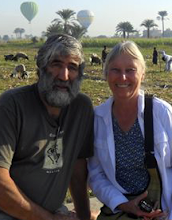
While we were visiting the sphinx, Mark went in to the temple and I waited outside. A small boy, maybe 6 or 7 came up and spoke to me with a few words of english. He wasn't selling anything, so I asked if I could take his photo.  He said yes and I took the picture.  I thanked him and offered him some money, but he politely refused.  He said I don't want money.  Another young boy walked up just then selling postcards and he said give him the money, which I did.  This was such a beautiful child, I really wanted to bring him home with me.


Children here are very curious about these pale faced foreigners and school groups often shout out, hi or hello or where you from and also wave to us when we're on the bus.  Just a little while ago, I heard shouting from the shore ( we're cruising) and looked out and children were madly waving.  Nice.

Tuesday, November 9, 2010

From Jerusalem to Safed by way of Masada

We did rent a car today and set off on our journey, a little late thanks to Avis. Our first difficulty was getting the car started after leaving Little House in Bakah. It turns out one needs to enter a code into a number pad before the car will start. OK, we're on our way. We get out of Jerusalem, no problem. Our thought was to head north to Tiberias, which would take us near the Dead Sea. When we got close, we decided to at least get a look, then realized Masada site of the defeat of the last rebel stronghold of the Jews by the Romans in 74 C.E. was within 60K, so we decided to go. It is certainly on most tourist agendas and is an amazing place. I would love to have seen it in King Herod's time, with the baths, public pools, palaces on different levels, and all of this on the top of a mountain in the Judean desert. When the Jewish rebels used it as their last stand, there were still large quantities of stored grain, which sustained them for at least 2 years, while the Roman build ramparts to reach the top.  The end is still the same. Facing defeat at Roman hands, at least 1,000 Jews, men, women and children, committed suicide rather than become slaves. 


After Masada, we headed north as planned. It was more than a little disconcerting to be a few big fences away from Jordan for many kilometers along the Jordan River. That area, both in Israel and Jordan is intensely farmed, much of it either under shade cloth or in hoop houses. I was disappointed to see so much plastic waste from it all over the land -we are talking about desert here, but water from the Sea of Galilee and river Jordan, which is not wide and deep, do make it bloom.   This is the Dead Sea.


As it turned out, our only difficulty was in negotiating the road through Tiberias, on the edge of the Sea of Galilee. 45 minutes, and thanks to some helpful Israelis, we re-found our route and headed north, looking for a likely place to spend the night. We pulled off the highway once where we saw a lodging sign, but found none. More traveling and we stopped at a larger city, Safed (also spelled Tsfed, Tzfed, Tifat. After a big shopping center, the road became a residential street and we were turning around when I noticed a clothing store. We stopped and I asked a man sitting outside about lodging. He said, he'd be happy to call around as people often stopped at his shop to ask and there was no central area for lodging. He found several, some too pricey, but one just right. A little chalet way up the mountain, overlooking the Sea of Galilee. It turns out, the local Moussad chief lives near by and there is a monitored electric gate to get to this street. I guess we'll be safe for the night.

The view is stunning, the bed comfortable, complimentary wine, breakfast in bed and we are set to head to Tel Aviv for the next part of this journey.


Deanna